Yama: The First Step in Yoga
Yoga is often associated with postures, breathwork, or meditation, but in Patanjali’s Yoga Sutras, the journey begins with something much simpler and much more profound: how we live in the world. Before we sit to meditate or practice pranayama, Patanjali reminds us that Yoga starts with yama — ethical guidelines, the restraints we observe to live in harmony with others and with ourselves.
What are the Yamas?
The word yama can be translated as “restraint” or “control.” They are the don’ts of Yoga: social rules, codes of conduct that shape how we interact with the outside world. While niyama looks inward (self-discipline and personal observances), yama looks outward, guiding us in relationship to others, situations, and society.
Patanjali describes five yamas in Yoga Sutras II:30:
Ahimsa — non-violence
Satya — truthfulness
Asteya — non-stealing
Brahmacharya — abstinence, non-indulgence
Aparigraha — non-possessiveness
In Sutra II:31, Patanjali adds that they are universal, applying regardless of time, place, or circumstances.

The Five Yamas in Detail
Ahimsa — Non-violence
Ahimsa means not harming in thought, word, or deed. It extends beyond not killing to include not disturbing balance, not spreading harmful intentions, and not polluting the environment. A person radiating negative thoughts still creates himsa, even if no words are spoken. When ahimsa is firmly established, Patanjali says (II:35), hostility disappears in its presence.
Satya — Truthfulness
Satya means aligning our words and actions with what is. It is more than “not lying” — it is seeing and expressing reality as it truly is, not as we perceive through limited perspective. True satya conveys reality clearly, without exaggeration, distortion, or manipulation. When truthfulness is established, Patanjali writes (II:36), actions bear their natural fruits without distortion.
Asteya — Non-stealing
Asteya is not only refraining from taking what is not ours in material terms, but also respecting ideas, time, and credit. Using someone’s words without acknowledgment, or consuming more resources than we need, is also a form of stealing. When asteya is steady, Patanjali says (II:37), abundance naturally comes to the yogi.
Brahmacharya — Abstinence / Non-indulgence
Traditionally understood as celibacy, brahmacharya is more broadly a discipline of energy. It is not about denying life, but about asking: does this support my spiritual path or distract from it? When approached without attachment or indulgence, even simple pleasures are fine. Brahmacharya means walking in reality with restraint, without addiction. Patanjali adds (II:38) that established brahmacharya leads to vitality and strength.
Aparigraha — Non-possessiveness
Aparigraha means not hoarding, not clinging to possessions, wealth, or even relationships. It is about simplicity and living free of clutter — both physical and mental. Take only what you need, nothing more. Patanjali explains (II:39) that when aparigraha is steady, knowledge of existence itself arises — freedom from dependence brings deep insight.
Yamas in Practice
According to Sage Vyasa’s commentary, the yamas (and niyamas) must be practiced in three ways:
Mind — cultivating pure thoughts and intentions.
Speech — speaking truthfully, kindly, and non-harmfully.
Action — behaving outwardly in a way that reflects inner discipline.
For example, ahimsa is not only refraining from physical violence, but also from harsh words or even harmful thoughts.
Indeed, the yamas are not abstract rules. They are living principles, meant to be applied in daily life:
In how we think about ourselves and others.
In how we speak, with honesty and kindness.
In how we act, respecting life, truth, and simplicity.
When these foundations are firm, the rest of Yoga unfolds naturally. Without them, no amount of asana or meditation can bring true transformation.
The SKY Perspective
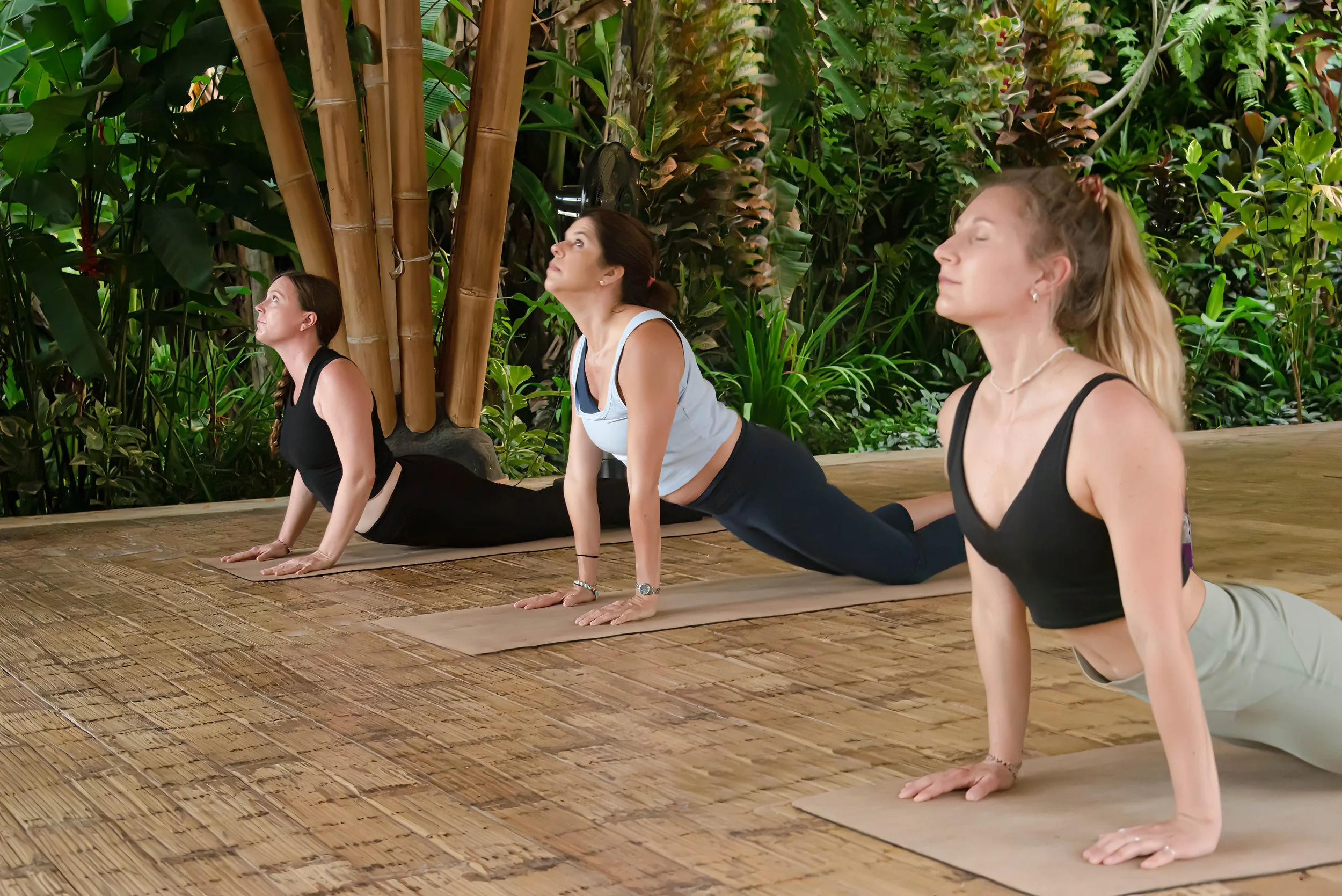
At SKY Yoga and Meditation, we see the yamas as the ethical ground on which all practice stands. They are not rules to follow rigidly, but principles to reflect on and live by. Practising ahimsa, satya, asteya, brahmacharya, and aparigraha creates harmony — with others, with nature, and within ourselves. Only when this ground is steady can meditation, pranayama, and asana lead to their true purpose: transformation and liberation.
Key Takeaways
Yama means restraint: the “don’ts” of Yoga, guiding how we live with others and in society.
Patanjali’s five yamas are ahimsa, satya, asteya, brahmacharya, and aparigraha.
They must be practised in thought, speech, and action.
Each yama has a transformative effect: ahimsa dissolves hostility, satya aligns us with reality, asteya brings abundance, brahmacharya builds vitality, and aparigraha reveals deep wisdom.
At SKY, yamas are the ethical foundation for authentic Yoga practice.
Learn and Practice with SKY Yoga and Meditation
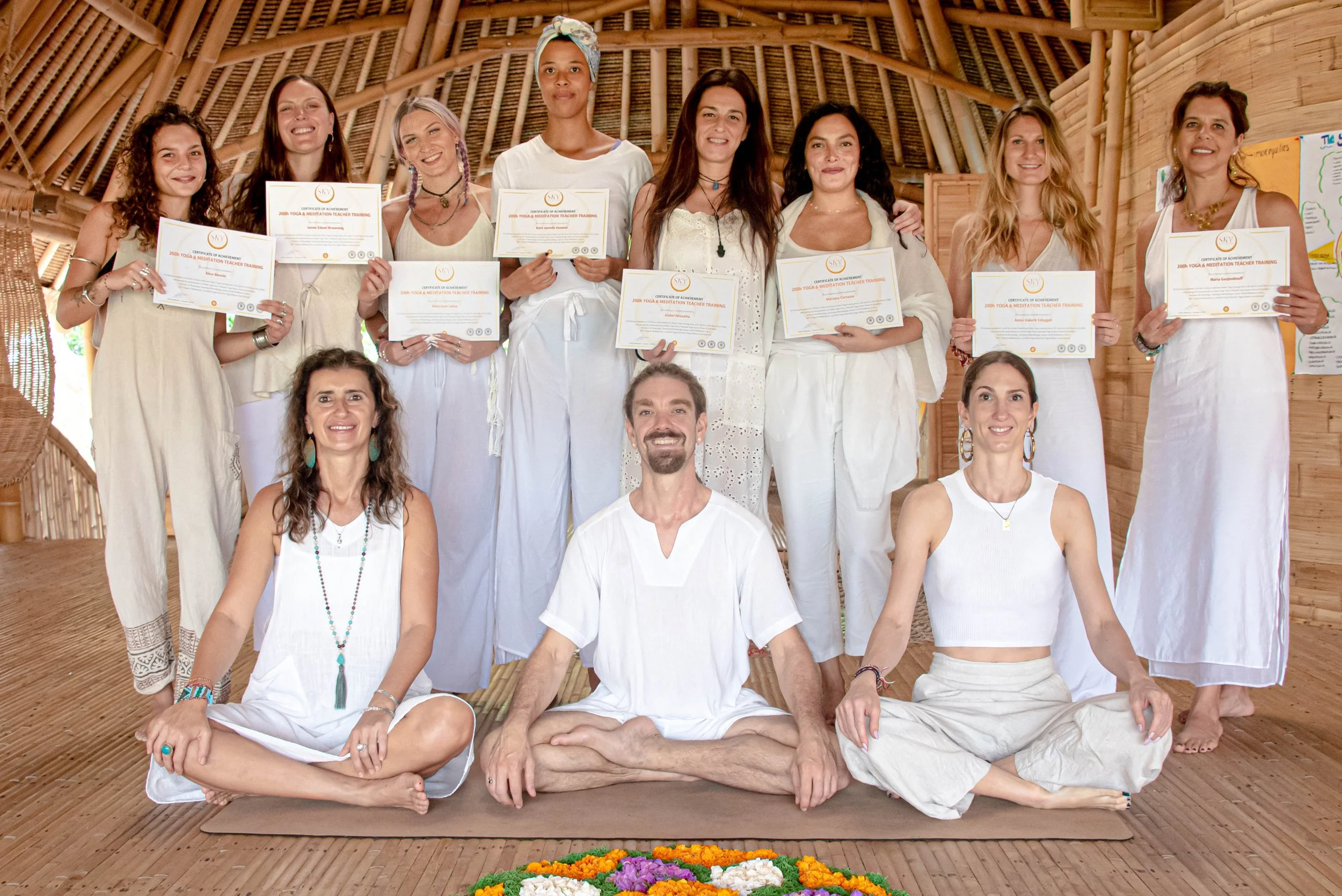
We are SKY Yoga and Meditation, the most traditional and authentic Yoga Teacher Training in Bali. Our Yoga center is located in a beautiful jungle eco-village in Pejeng, near Ubud. Our mission is simple but profound: to share Yoga as authentically as possible, rooted in tradition and lineage, while offering a space for deep practice and transformation.
If you feel inspired to explore these teachings further, we welcome you to join us:
200-Hour Yoga Teacher Training in Bali — a foundational, immersive program designed to give you not only teaching skills but also a living experience of authentic Hatha Yoga.
300-Hour Advanced Yoga Teacher Training — for those ready to deepen their path, refine their practice, and step into the next level of teaching and self-mastery.
Weekly Yoga and Meditation Classes — open to all, held in our bamboo shala overlooking the lush Ubud jungle, offering a taste of SKY’s unique blend of traditional teaching and supportive community.
Whether you are preparing to teach, seeking to deepen your personal practice, or simply curious to begin, SKY provides the guidance, environment, and authenticity that allow Yoga to unfold in its truest sense.
For more details or a fast answer to your questions, send us an email or WhatsApp us directly.
We would love to welcome you into our community here and introduce you to the most authentic Yoga courses in Bali to see for yourself how life-changing traditional Yoga can truly be.